
Youth Reporting Center Has No Releases
The Ohio and Marshall County Youth Reporting Center is a community-based program operated within West Virginia’s juvenile services structure. The research describes pre-petition and post-petition programming. A petition is the formal juvenile-court filing that begins or advances a case. “Pre” and “post” describe the case stage, not secure custody and discharge.
A youth can report to programming and then return to an approved home or placement. Ending a session, completing a program, or changing a schedule is not an inmate release. The WVDCR fiscal year 2005 report supplies dated historical program context, not a current participant list. There is no support for an online jail roster, release hour, booking file, 24-hour release list, or adult discharge search for this center. Its inclusion in the facility map prevents readers from mistaking a community program for the secure Ronald C. Mulholland Juvenile Center or an adult WVDCR facility.
Youth Reporting Center Program Records
Questions about attendance, completion, referral, or a transition belong with the authorized program and juvenile case team. The answer can depend on the youth’s case stage and the directions issued by the responsible court or agency. A public adult database cannot resolve those facts. An authorized person should use the case number or approved identifier and provide only the information requested in a private channel.
- Diversion
- A structured response that may address a juvenile matter outside a standard adjudication path.
- Community reporting
- Required or approved program contact while the youth remains in the community.
- Petition
- A formal filing in juvenile court.
- Program completion
- The end of assigned services or requirements, not an adult release from jail.
Program status should not be converted into claims about guilt, custody, or a public record. A missed appointment does not prove detention. Attendance does not prove a court outcome. Completion does not prove the end of every case duty. Ask the assigned professional what the event means for that youth and what, if anything, remains required.
Youth Reporting Center Records Contact
The program has a Wheeling street address and direct telephone number. No public walk-in records schedule, routine release process, or public participation roster was verified. Call for current program procedure. Do not arrive expecting a jail lobby, inmate desk, or pickup gate.
Ohio and Marshall County Youth Reporting Center225 McColloch Street, Unit G
Wheeling, WV
Telephone: 304-230-0367
The address establishes that the program operates in the community. It does not show where any youth lives or whether that youth is currently enrolled. Program details and individual case information are separate, and only the latter is subject to role-based disclosure.
Youth Reporting Center Record Privacy
Juvenile records require special treatment under West Virginia law. A general public-record request does not make a child’s identity, case plan, family data, treatment information, attendance, or transition available for open inspection. West Virginia FOIA also contains exemptions in §29B-1-4. The relevant court and agency decide what may be disclosed to a requester with proper authority.
An authorized request should be narrow. State the requester’s role, identify the record needed, and ask what consent or proof of identity is required. Use a secure delivery method. If the office withholds information or refers the request to another custodian, follow that instruction rather than reconstructing the record through rumors, social posts, or adult databases.
| Question | Appropriate source |
|---|---|
| Current program schedule | Youth Reporting Center or assigned case professional |
| Meaning of completion | Referring agency, counsel, or juvenile court |
| Secure placement question | Authorized juvenile facility and court contacts |
| Copy of a case record | Named custodian with required authority |
Note: The absence of a public result reflects the protected and non-custodial nature of the program, not proof that no authorized record exists.
Youth Reporting Center Facility Records
Ronald C. Mulholland Juvenile Center provides secure juvenile placement. The Youth Reporting Center provides community programming. Northern Regional Jail and Correctional Facility serves adult regional-jail populations, including Ohio County commitments. OCCCJ serves a state correctional and technical-parole-violation role. These four names should never be blended into one roster or one release procedure.
| Place | Role | Public adult release search? |
|---|---|---|
| Youth Reporting Center | Community youth program | No |
| Mulholland Juvenile Center | Secure juvenile facility | No; juvenile confidentiality applies |
| Northern Regional | Adult regional jail and correctional complex | Current adult jail channel plus official confirmation |
| OCCCJ | Adult state correctional and parole-violation setting | Adult prison and supervision channels |
The distinction is more than a label. It determines the right law, requester, record, and contact. The Ohio County adult custody search is limited to the adult pathways and does not invite juvenile identification. A youth-program question should remain with the authorized juvenile process from start to finish.
Regional Youth Center Record Context
The program’s name reflects two neighboring counties. Regional cooperation is common in the northern panhandle, where services and correctional systems cross county lines. That geography does not create a public list of youth participants. It means a family or authorized professional should verify which county, court, and provider manages the case rather than assuming the Wheeling address answers every question.
The West Virginia reentry council directory shows broader regional resource coordination. The accompanying source capture documents that regional coverage as community context, not as a Youth Reporting Center roster or a promise of a specific service.
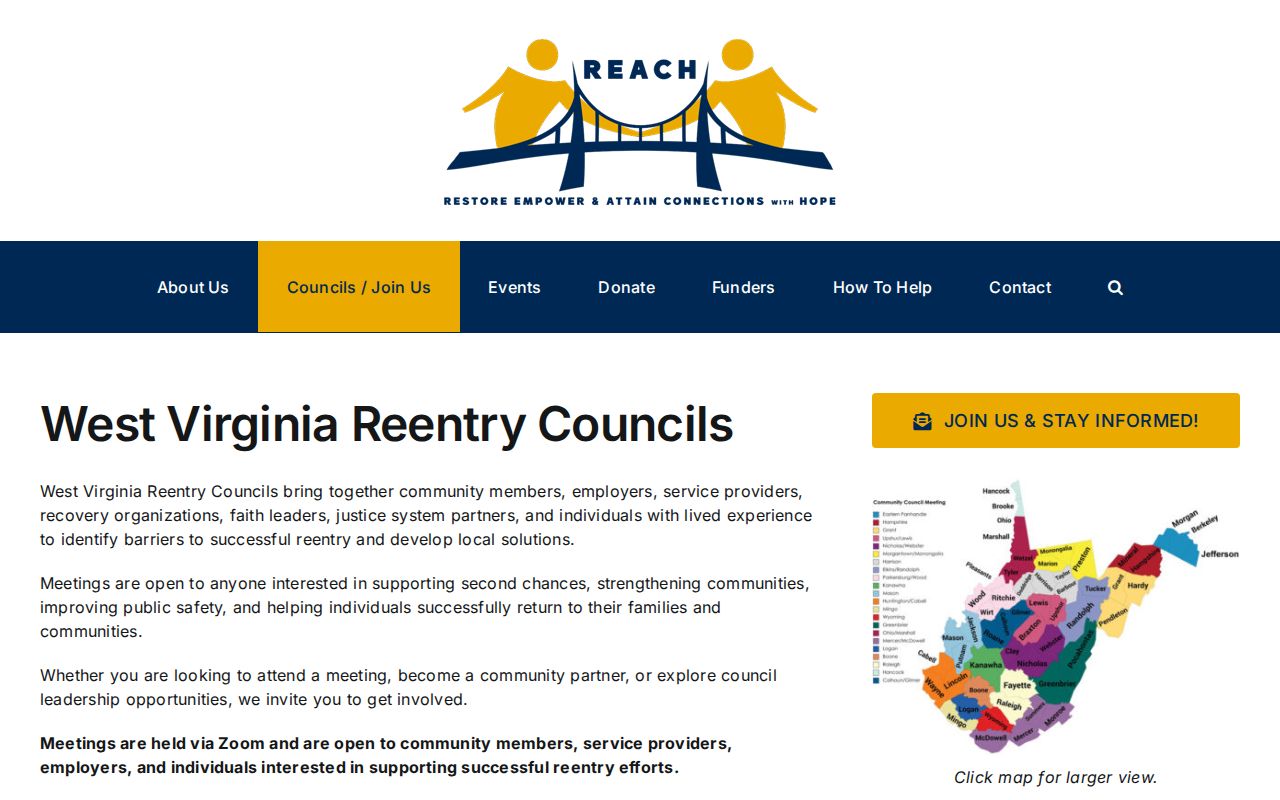
The resource view reinforces that program and service navigation differs from custody confirmation. An authorized youth case plan remains the source for actual referrals.
Ohio County Facility Name History
Ohio County’s adult jail history can misdirect searches. The old county jail stopped serving as the general jail in 1994 when Northern Regional opened in Marshall County. The Wheeling building later returned to state correctional use as OCCCJ. That history explains why an adult county arrest may be housed outside Ohio County and why the county-named building has a different population.
None of that adult history changes the Youth Reporting Center’s role. It remains community programming, not the old jail, a regional-jail branch, or a release annex. A person should not call the program to locate an adult detainee. For an adult arrest, use Northern Regional and the WVDCR jail channel. For an OCCCJ technical parole placement, use the prison and supervision path.
Likewise, West Virginia’s adult immigration-custody handoff rules should not be mapped onto youth-program attendance. ICE’s public detainee locator excludes minors. If another authority is known to be involved in a juvenile matter, authorized counsel and the juvenile court must handle that question. Public adult locators do not supply an answer.
Use the program contact only for a legitimate program question and follow any identity-verification steps staff require. A public-record request cannot be used to force disclosure of a protected juvenile participant list. The responsible juvenile court or authorized case professional determines what can be shared and with whom.