
Sheriff Records, Not Releases
The Ohio County Sheriff’s Office performs county law-enforcement and court-process work. It may hold an arrest report, an agency-created photograph, property or evidence documentation, and a transfer-to-WVDCR record when its deputies made the arrest. Those records explain the Sheriff’s part of the event. They ordinarily do not include Northern Regional’s final release or movement entry because the Sheriff does not operate that facility.
Ohio County’s old county jail stopped serving as the general jail in 1994 when Northern Regional opened in Moundsville. That history explains why the Sheriff site has no inmate roster, booking log, recent-release feed, or jail mobile app in the reviewed material. A person arrested by the Sheriff generally enters the WVDCR regional-jail path. The active jail search, facility confirmation, VINE, and WVDCR records answer the custody side.
Confirm Release After Sheriff Arrest
Start with the WVDCR offender-search landing page and choose the jail search. Match Northern Regional and Ohio County case context. If the person appears, the result supports active recorded jail custody, subject to WVDCR’s accuracy warning. If the name is absent, do not announce release. Check VINE, the court, and the facility.
- Search the WVDCR jail channel and save the date, time, spelling, and identifiers checked.
- Review the Ohio County Magistrate or Circuit Court docket for the latest signed bond, dismissal, sentence, or modification order.
- Search VINELink for the same person and confirm the reporting agency.
- Call Northern Regional at 304-843-4067 for current placement or movement information that staff may disclose.
- Ask WVDCR for the release or movement entry when the actual time, type, or destination is needed.
- Ask the Sheriff only for its arrest, agency-image, transfer, or court-process record.
The Ohio County released-person workflow gives the full county search sequence. It also routes a prison sentence into WVDCR’s prison search. Note: A court order gives release authority, but processing or another hold may delay or redirect the physical exit.
Request Sheriff Arrest Records
A useful Sheriff request identifies the person, approximate arrest date, location, deputy or incident number if known, and the related Ohio County case number. Ask for specific existing records: the incident or arrest report, an agency-created photograph if retained and public, property documentation, and the record of transfer to WVDCR. The Sheriff FAQ supports a $15 charge for a police report only. Do not call it a jail discharge fee. The official county Sheriff page provides the office contacts.
Ohio County Sheriff's Office Records51 Sixteenth Street
Wheeling, WV 26003
Records: 304-234-3792
Law enforcement: 304-234-3680
Non-emergency: 304-234-3606
Monday through Friday, 8 a.m. to 4 p.m.
| Record sought | Likely custodian |
|---|---|
| Sheriff incident or arrest report | Ohio County Sheriff |
| Deputy-created photograph | Sheriff, if created, retained, and disclosable |
| Northern Regional booking file | WVDCR |
| Actual jail release or movement entry | WVDCR / Northern Regional |
| Bond, dismissal, or sentence order | Ohio County court clerk |
A referral is not a dead end. It identifies the office that created the requested record. Ask the Sheriff to state which requested items it holds and which belong to WVDCR or the court.
Sheriff Public Record Rules
West Virginia FOIA §29B-1-3 requires a reasonably specific request and a response as soon as practical within the statutory five-day period excluding weekends and legal holidays. The public body may produce records, set an inspection time and place, or deny access in writing with reasons. Existing electronic records must be available electronically when requested. Actual reproduction costs may apply, but the section does not allow search, retrieval, or man-hour charges.
Exemptions can protect active-investigation details, personal or medical information, victims, juveniles, security content, sealed matters, and other protected material. A request should ask for segregable public portions, meaning any nonexempt part that can be separated. The law does not require an office to create a new explanation or combine data into a release list that it does not maintain.
There is no verified Sheriff-hosted 24-hour or 72-hour release feed. The WVDCR Daily Incarcerations product is an admissions summary, not a release report. Neither source should be relabeled to answer “who got out.” Historical confirmation belongs in the specific WVDCR movement record and the supporting court authority.
Sheriff Images and Expungement
A Sheriff-created image and a WVDCR booking photograph may be different records. Ask the office that created each image. West Virginia’s booking-photo social-media rule in §62-1-6a applies narrowly to covered law-enforcement agencies and certain minor-offense postings. It creates event-based removal duties after a proper request in listed outcomes. It is not automatic removal at physical release, and DCR is expressly excluded from that section’s agency definition.
The official arrest and dismissal expungement statute describes a separate court-based record-relief path. The accompanying official statute capture applies to Sheriff record questions and should be read with the actual court order, not reduced to a claim that every release erases an arrest.
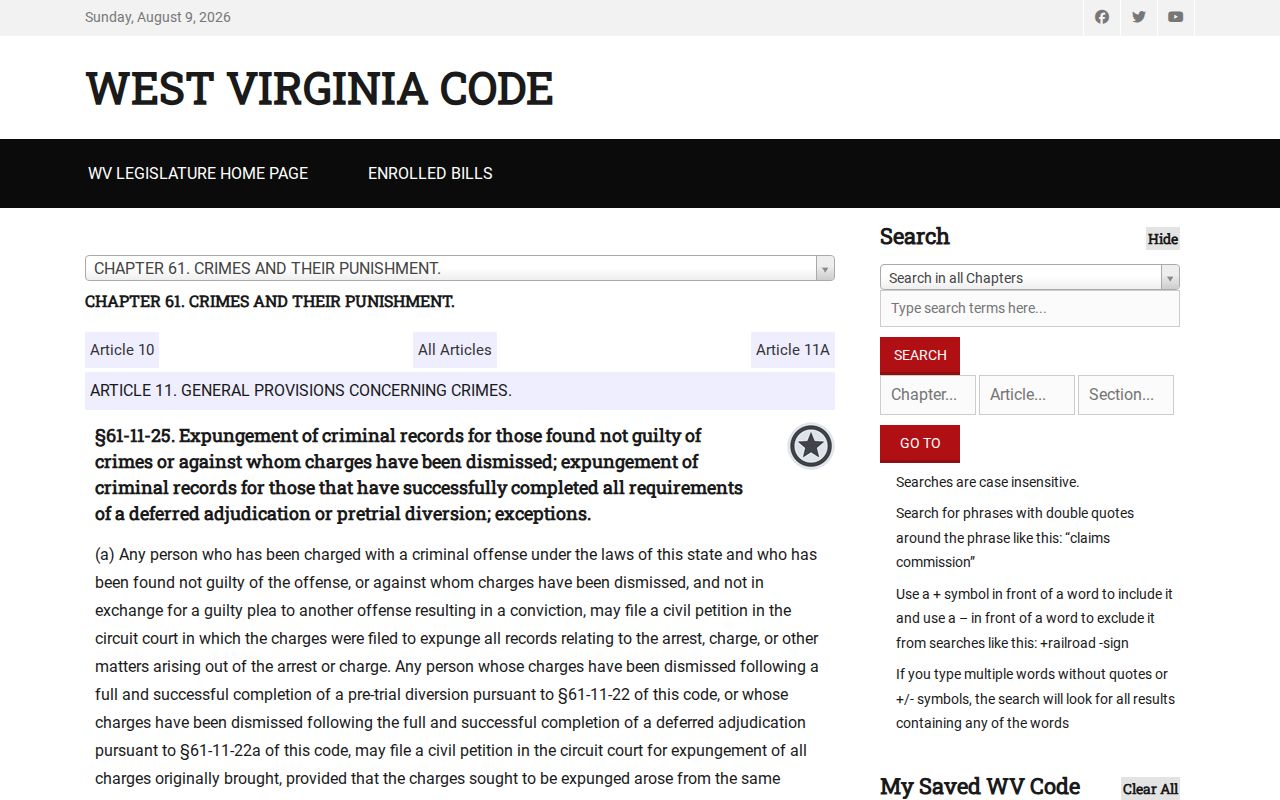
The statute page supports checking the exact legal path. Eligibility, exclusions, and the scope of a granted order depend on the case, so the clerk’s and agency’s official response controls.
Sheriff Arrest and Court Authority
Ohio County Magistrate Court handles initial appearances, many misdemeanor matters, warrants, bonds, and early felony proceedings. Circuit Court handles felony disposition, sentencing, modification, and revocation matters. Wheeling Municipal Court handles city citations. A Sheriff arrest can lead into either county court level depending on the matter, but a city police arrest may begin with Municipal Court.
The signed order answers why release was authorized. It does not always state when Northern Regional finished processing the person, and another hold may prevent community exit. Match it with VINE or the WVDCR movement entry. Conversely, a WVDCR transfer does not settle whether charges were dismissed, a sentence was imposed, or another case remains pending.
- Bond
- A court-set condition allowing release while a case continues.
- Dismissal
- A court or prosecution action ending a charge at that stage.
- Detainer
- A hold or request from another authority that can redirect release.
- Expungement
- Court-ordered record relief available only under applicable law and case facts.
Sheriff and Ohio Jail History
Ohio County’s sheriff once operated alongside a county jail in Wheeling, but that general jail role ended in 1994 when Northern Regional opened in Marshall County. WVDCR later returned the old building to state correctional use as OCCCJ. The name remains local, yet the current populations and custodians differ.
This history explains the modern records split. The Sheriff can document an arrest or transfer it handled. Northern Regional and WVDCR document adult regional-jail custody. OCCCJ and WVDCR document the specialized state correctional and parole-violation path. Confirm the facility before sending a release request.
Sheriff Arrest Custody Handoffs
Some Northern Regional departures continue in another authority’s custody. A state sentence may send the person into the WVDCR prison system. A federal writ or hold may involve the U.S. Marshals Service and later the BOP. West Virginia’s announced 287(g) warrant-service model also permits designated correctional officers to execute immigration warrants at scheduled criminal release and transfer custody to ICE.
The Sheriff’s original arrest report may not record those later events. Ask WVDCR for the movement entry and receiving agency. Use ICE’s current locator only when an immigration handoff is relevant, and remember that a no-result is ambiguous. Use BOP for sentenced federal custody, not to verify a Northern Regional release on an unrelated state case.
The proper conclusion may be “released from WVDCR to another custodian.” It should not be shortened to “released to the community.” The final custody chain comes from the jail movement, receiving system, and legal order together.
When requesting that chain, identify the Sheriff arrest record and the later WVDCR record as separate documents. Include the case number, arrest date, Northern Regional placement, and the suspected receiving agency. That detail helps each custodian locate its own part without implying that the Sheriff controls the later release.