
Ohio County Projected Release Dates
The WVDCR prison detail uses the exact field name “Projected Release Date.” It is a sentence-administration estimate. It is not the same as a parole eligibility date, hearing date, minimum discharge date, maximum sentence, conditional-release date, or actual release time. Each term marks a different stage, and some apply only to certain sentences.
Population matters first. A pretrial Ohio County detainee at Northern Regional awaits court action and usually has no sentence-based release calculation. Bond, dismissal, a plea, time served, or another order may create release authority. A sentenced state offender or OCCCJ resident can have a WVDCR calculation. Someone on parole has left secure prison custody but remains under supervision, so a portal result can persist after the prison exit.
- Projected release date
- WVDCR’s current administrative estimate based on its sentence data.
- Parole eligibility date
- The date consideration may begin, not a right to release.
- Minimum discharge
- A sentence calculation shaped by credit, good time, and applicable law.
- Actual release
- The recorded physical movement out of a facility.
- Final discharge
- The recorded end of custody or supervision.
Find Ohio County Projected Release Dates
Choose the search from the person’s custody type, not from the county name alone. Ordinary Ohio County arrests are generally sent to Northern Regional Jail in Moundsville. OCCCJ in Wheeling is now a state facility for male technical parole violators. The public WVDCR landing page separates the jail and prison databases because they answer different questions.
- Identify the latest court case and determine whether the person is pretrial, serving a local sentence, serving a state sentence, or under parole supervision.
- For Northern Regional current custody, use the WVDCR jail search, then read the Ohio County court docket and signed order.
- For OCCCJ or state prison custody, open the WVDCR prison search.
- Search with the first four OID digits or at least the first three letters of both first and last name, then match birth and location details.
- Open “More Info” and read the Projected Release Date with the offense, court-order, intake, and location context.
- Request an updated WVDCR time sheet and minimum discharge computation when an authoritative current calculation is needed.
- After the anticipated date, verify the actual movement through VINE, the facility, and the release record.
A fully discharged person may no longer appear because the prison portal covers active WVDCR custody and supervision rather than a permanent historical archive. A no-result does not erase the state record. For older proof, request the historical offender record and actual release entry.
Ohio County Good-Time Release Rules
Under West Virginia Code §15A-4-17, an eligible adult committed to DCR generally earns one day of good time for each day physically incarcerated. Credited presentence jail days can count when the sentencing court awards them under §61-11-24. Good time is deducted from the maximum term of an indeterminate sentence or the fixed term of a determinate sentence. It does not accrue while a person is on bond or parole, and life sentences receive none.
The rule has exclusions. Youthful-offender and extended-supervision categories identified in the statute do not receive the same treatment. Consecutive eligible terms are combined for the calculation. Discipline can lead to forfeiture of some or all earned credit, while a superintendent may restore it with approval. WVDCR must provide an initial sentence statement and revise the earliest discharge calculation when a loss or restoration changes it.
Presentence credit comes from the sentencing court. It should be checked against the commitment order and WVDCR time sheet rather than counted from an arrest date. Time spent on bond does not earn good time. If multiple cases overlap, the concurrent or consecutive terms in the signed orders determine how the periods combine. A missing day, later credit order, or corrected commitment can therefore alter the public projection without any new offense or disciplinary event.
The commissioner may grant extra good time for meritorious or emergency service. An eligible felony inmate can also receive up to 90 days for each approved optional academic or vocational program. These credits are record-based. They should not be estimated from a course name or from time already served.
The official good-time statute shows the rules that can alter an Ohio County state sentence.
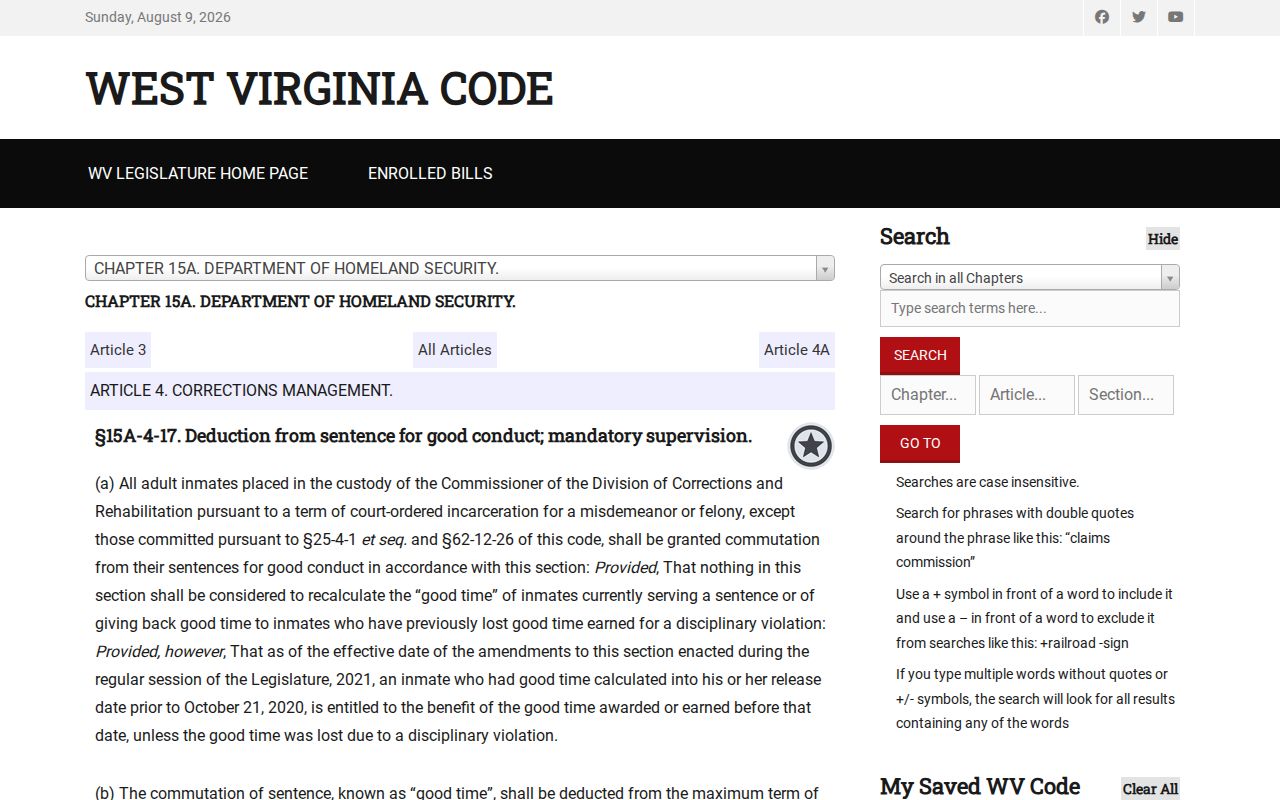
The statutory text supplies the framework, while the individual sentencing order and current WVDCR time sheet control the actual calculation.
Ohio County Release-Date Calculation Quirks
West Virginia does not use a universal “serve 85 percent” rule under §15A-4-17. The accurate model combines one-for-one eligible good time with exclusions, sentence structure, court-awarded jail credit, loss and restoration, added program credit, offense-specific minimums, and forms of mandatory supervision. Importing a percentage from another state can produce a false date.
Some accumulated good time is converted into supervision rather than unrestricted release. For designated violent-person, minor-victim, or firearm felonies committed on or after the statutory date, one year is taken from accumulated good time to provide a year of mandatory post-release supervision. For other felonies, a sentencing court may order up to 180 days of the sentence through mandatory supervision.
Section 15A-4-17a separately permits an optional 180-day mandatory supervised-release plan for some eligible felony inmates who were not granted discretionary parole before minimum expiration. The person is considered released on parole for that provision, but supervision continues until minimum expiration.
The optional-supervision statute is a key source for interpreting a date that marks movement into supervised release.
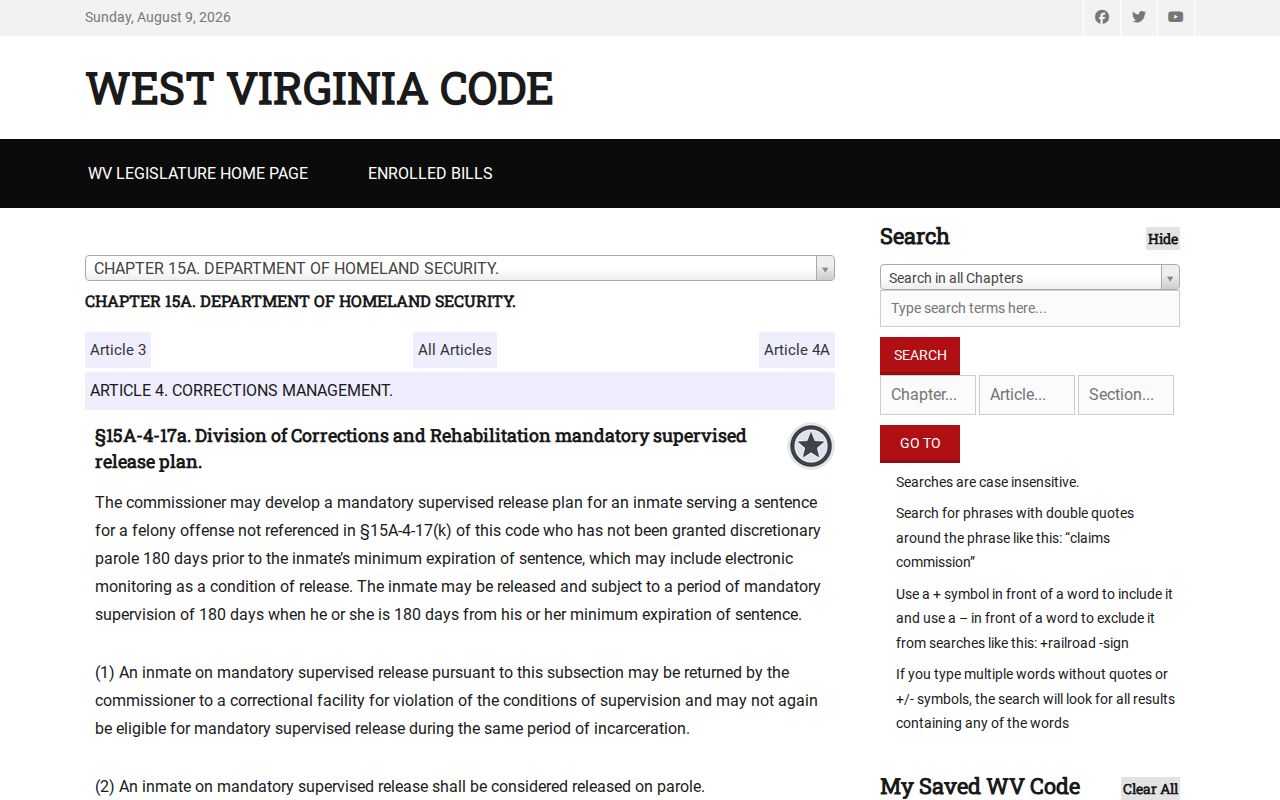
This pathway demonstrates why the end of physical custody and the end of the sentence can fall on different dates.
Note: Sentence rules depend on offense date and the law applicable to the judgment, so a current WVDCR computation is essential.
Ohio County Release-Date Changes
A projected date can move earlier or later. Some changes correct the data used in the first calculation. Others reflect conduct in custody, a new court order, a parole decision, or an outside hold. The public portal can also lag behind an agency action. Reading one date without the sentence and movement history hides those causes.
| Change | Effect to verify |
|---|---|
| Corrected jail credit | Changes credited physical custody days |
| Concurrent or consecutive ruling | Changes how multiple terms combine |
| Amended sentencing order | Replaces part of the legal calculation |
| Good-time loss or restoration | Moves the minimum discharge calculation |
| Approved program credit | May add statutory extra credit |
| Parole action | May permit supervised release but not fix the gate time |
| Detainer or writ | May cause transfer to another authority instead of community release |
A detainer is a request by another authority to hold or transfer a person when the present case ends. An Ohio County release may therefore become a handoff to another regional jail, state prison, USMS, or ICE. The WVDCR movement code and receiving agency are vital. A projected release date alone cannot distinguish these outcomes.
Database timing adds another source of change. WVDCR warns that public information may not reflect the true current location, date, or status. Save the date of each search and avoid treating an older screenshot as a current calculation. When the number changes, compare the new time sheet with the last sentencing order and ask which credit, loss, restoration, or legal event caused the revision. The agency record, not a hand calculation, supplies the operative answer.
Ohio County Parole Eligibility Dates
Parole eligibility is not projected discharge. Under §62-12-13, the baseline commonly begins after the minimum term of an indeterminate sentence or one-fourth of a definite term, but serious, repeat, life, firearm, and other cases have special rules. Section 62-12-13a makes the key point: reaching eligibility permits consideration and creates no right to parole.
The Parole Board’s monthly calendar is a scheduling tool. It does not publish a release outcome. Even a grant can come before actual exit because WVDCR may need intake, fingerprinting, an approved home plan, required programming, and other release processing. The Board advises that a regional-jail parole grant can involve transfer and a wait of roughly seven to ten days. That guidance must not be turned into a promised date for an individual.
When the calendar lists OCCC, ask the Board whether the hearing occurred and request the final action if no decision is online. Then match it to the WVDCR movement entry. For a live alert during that transition, the Ohio County VINELink check can help, subject to its transfer-notification gap.
Confirm Ohio County Actual Release
The actual release record closes the gap between an estimate and an event. For Northern Regional, obtain the court’s signed authority, check VINE, contact NRJ, and request the WVDCR release or movement entry. A court bond order may exist before processing is complete or another hold is resolved. Current jail presence still means release has not been proved.
For OCCCJ or state prison, pair the prison search with the Parole Board or court action, the time sheet, and the movement record. Active parole can remain visible after prison release because supervision continues. Final discharge comes later and should be verified through its own record. For past cases that have left public portals, court dockets and formal WVDCR requests provide the durable trail.
The Ohio County release-record lookup sets out the full custody, court, and supervision chain. Use it when a displayed projected date has passed but the actual disposition remains unclear.
A focused WVDCR request can ask for the latest time sheet, minimum discharge computation, credited jail time, and actual release or movement entry. Those existing records show whether the public date was revised and whether the person left physical custody, began supervision, or transferred to another authority.
Note: Preserve each search date and describe an absent result only as not found, never as proof that custody ended.